
HIPAA Compliant AI for New York Healthcare: 2026 Guide
Learn essential requirements for HIPAA compliant AI in New York healthcare. Ensure your AI systems safeguard patient information effectively.

HIPAA Compliant AI for New York Healthcare: 2026 Guide
Any AI system that processes protected health information (PHI) in a clinical setting must meet a specific set of legal and technical requirements to qualify as HIPAA compliant AI. For New York providers, that bar is higher than the federal baseline alone. Here is what compliance actually requires:
- Business Associate Agreement (BAA): Every AI vendor touching PHI must sign a BAA. Without one, the vendor relationship is a HIPAA violation regardless of the platform's technical capabilities.
- Encryption: PHI must be encrypted at rest and in transit using industry-standard protocols such as AES-256.
- Audit and access controls: Role-based access control (RBAC), multi-factor authentication, and full activity logging are required under the HIPAA Security Rule.
- Continuous risk assessment: The 2025 HHS proposed Security Rule revision requires a written inventory of all AI assets handling ePHI and regular vulnerability monitoring.
- Administrative, technical, and physical safeguards: All three categories apply to AI systems, not just the technical layer.
- Vendor monitoring: Compliance does not end at contract signing. Model updates and data handling changes can introduce new risks post-deployment.
Why HIPAA compliance matters for AI in healthcare
AI is now embedded in clinical workflows across New York's hospital systems and private practices. The use cases span clinical documentation automation, diagnostic decision support, revenue cycle management, patient communications, and chronic-care monitoring. Each of these involves PHI at some stage, which brings the full weight of HIPAA's Privacy and Security Rules into play.
The HIPAA Privacy Rule governs how PHI is used and disclosed. The Security Rule governs electronic PHI (ePHI) specifically, requiring confidentiality, integrity, and availability controls. The Breach Notification Rule adds mandatory reporting obligations when unsecured PHI is compromised. All three apply to covered entities and their business associates, which includes AI vendors operating within those workflows.
Training AI on PHI creates a distinct compliance problem. Using PHI for model training typically falls outside Treatment, Payment, and Operations (TPO), meaning explicit patient authorization is required. Obtaining that authorization at scale is logistically difficult for most clinical organizations. The practical workaround is de-identification or pseudonymization of training data, but that process must itself meet HIPAA's de-identification standards.
Non-compliance carries real financial exposure. Civil penalties reach $50,000 per violation, including for violations the organization did not know about. Criminal penalties for knowing violations can include imprisonment. Beyond fines, a breach involving AI-processed PHI carries reputational damage that is difficult to quantify and harder to recover from.

One structural point that many providers miss: "HIPAA-eligible" is not the same as "HIPAA-compliant." A platform may offer the infrastructure to support compliance, but the covered entity is responsible for configuring encryption, audit trails, and access controls correctly. The legal obligation does not transfer to the vendor simply because a BAA is signed.
What New York regulations add on top of HIPAA
New York providers operate under a layered regulatory environment. Federal HIPAA sets the floor; state law frequently raises it.

| Regulation | Scope | Key Requirement for AI |
|---|---|---|
| New York SHIELD Act | All entities handling NY residents' data | Reasonable security audits; continuous monitoring for AI processing biometric and voice data |
| NYC Local Law 144 | NYC employers using automated employment decision tools | Bias audits and public disclosure; extends governance expectations to clinical AI contexts |
| NY Senate Bill 2025 | AI algorithm audits in regulated sectors | Audit-proof documentation for AI systems; clinician oversight mandates |
| HIPAA Security Rule (2025 proposed revision) | All covered entities and business associates | Written AI asset inventory; prompt vulnerability remediation; tightened encryption standards |
Key compliance tasks that New York state law adds to the federal baseline:
- SHIELD Act audits: The New York SHIELD Act requires reasonable security audits for any vendor processing biometric or voice data, which directly affects AI tools used in telehealth and voice-based clinical documentation.
- Local Law 144 governance: NYC Local Law 144 imposes AI governance and transparency requirements that go beyond HIPAA, particularly in clinical and mental health contexts where automated decision tools interact with patient care pathways.
- Clinician oversight: New York legislation increasingly requires human clinician review of AI-generated clinical recommendations, especially in mental health applications. Autonomous AI decisions without documented oversight create both regulatory and liability exposure.
- Informed consent: State-level requirements for patient disclosure of AI use in care delivery are expanding. Providers should review their Notice of Privacy Practices to confirm AI use cases are disclosed.
A "HIPAA-first" governance approach, as outlined in legal advisories from firms like Morgan Lewis, means identifying every PHI-touching AI use case before deployment, executing BAAs immediately, and building a risk documentation trail that satisfies both federal and state auditors simultaneously.
How leading HIPAA-compliant AI providers compare
Three providers with demonstrated presence in the New York market offer distinct profiles for healthcare organizations evaluating compliant AI solutions.
| Provider | Core services | Certifications | Specialized functions | Pricing | New York presence |
|---|---|---|---|---|---|
| Heidi AI | Clinical documentation, patient communications, revenue cycle management, decision support | HIPAA, SOC 2, GDPR, Cyber Essentials+ | Remote clip-on mic hardware, specialty pharmacy refills, chronic-care monitoring, pre-charting | Free tier available; enterprise demo on request | Active in NY market |
| AI Humanizer | Clinical documentation, compliance consulting | HIPAA-focused | Specialized documentation workflows | Not publicly listed | NY-area services |
| HIPAA Compliance to | Compliance consulting, AI governance advisory | HIPAA-focused | Compliance audits, policy development | Not publicly listed | NY-area services |
Heidi AI carries the broadest certification stack of the three, with SOC 2 and Cyber Essentials+ alongside HIPAA and GDPR. Its hardware integration (a remote clip-on microphone for ambient note-taking) addresses a workflow gap that pure-software platforms cannot close. AI Humanizer and HIPAA Compliance to serve providers whose primary need is documentation support or compliance advisory rather than full clinical workflow automation. All three offer BAAs, which is the non-negotiable starting point for any vendor evaluation.
Pro Tip: Ask every vendor for their BAA before any technical evaluation. If they hesitate or offer a modified version that limits their liability for PHI handling, treat that as a disqualifying signal.
How to implement and maintain HIPAA-compliant AI in your practice
Deployment is not a one-time event. The compliance posture of an AI system must be actively maintained across its entire operational life.
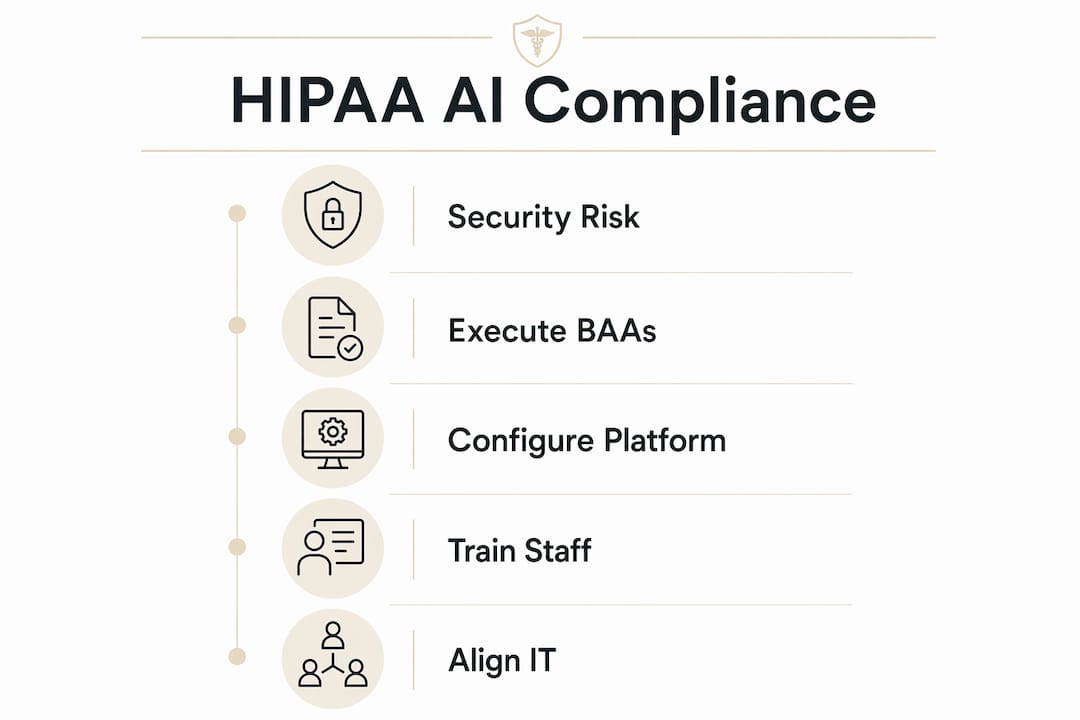
Step 1: Conduct a Security Risk Assessment
Before any AI tool goes live, perform a formal SRA. The ONC provides a downloadable SRA Tool designed for small to medium providers, but larger organizations should supplement it with legal and technical review. The assessment must map how PHI flows through the AI system's clinical logic, not just the network perimeter. Many audits fail precisely because PHI flow documentation stops at the firewall and does not trace data through model inputs, outputs, and logging systems. An AI risk register built specifically for HIPAA contexts helps maintain that documentation over time.
Step 2: Execute BAAs before any PHI touches the system
Consumer AI products do not offer BAAs. Standard ChatGPT does not sign BAAs and must not be used to process PHI. Enterprise platforms, including OpenAI for Healthcare (which offers BAAs for eligible API customers), are structured differently. The BAA must be in place before any PHI enters the system, not retroactively.
Step 3: Configure the platform, not just procure it
HIPAA-eligible platforms require the covered entity to configure encryption, audit trails, and access controls. Procurement alone does not create compliance. Assign workflow ownership to a named individual, document every configuration decision, and retain that documentation as part of your technical evidence trail.
Step 4: Train staff and audit continuously
Update workforce training to cover approved AI use cases and the specific risks of using PHI in AI tools. Conduct regular audits of access logs, model outputs, and vendor practices. Compliance gaps often emerge after deployment when vendors update models or change data handling practices without notifying covered entities.
Pro Tip: Schedule a quarterly vendor review that specifically asks whether any model updates, infrastructure changes, or subprocessor additions have occurred since the last review. Vendors are not always required to proactively notify you, and a model update can change how PHI is processed.
Step 5: Align AI with existing healthcare IT infrastructure
AI tools must integrate with EHR systems, identity management platforms, and existing audit infrastructure without creating data silos or bypassing access controls. Use the NIST AI Risk Management Framework alongside HIPAA to evaluate trustworthiness, explainability, and security across the full system, not just the AI component in isolation.
Subodhkc brings deterministic governance to HIPAA-compliant AI
Healthcare providers navigating both federal HIPAA requirements and New York's layered state regulations need more than a checklist. Subodhkc architects production AI systems with compliance built into the design, not added later after deployment. The HAIEC platform provides deterministic governance frameworks that map PHI flow through AI clinical logic, generate audit-ready documentation, and satisfy the written asset inventory requirements of the 2025 HHS Security Rule revision. For New York providers managing Local Law 144 obligations alongside HIPAA, Subodhkc's AI governance and compliance platform addresses both regulatory layers within a single architecture. Advisory engagements and the live AI Governance Masterclass give administrators the technical and legal grounding to deploy AI without audit exposure. Start with a compliance readiness assessment to identify where your current AI posture creates risk.
Key Takeaways
HIPAA-compliant AI in New York requires a signed BAA, configured encryption and audit controls, a formal Security Risk Assessment, and continuous vendor monitoring to satisfy both federal and state regulatory obligations.
| Point | Details |
|---|---|
| BAA is non-negotiable | Every AI vendor handling PHI must sign a BAA before any data enters the system. |
| "Eligible" is not "compliant" | Covered entities must configure encryption, access controls, and audit trails themselves on eligible platforms. |
| New York adds requirements | The SHIELD Act, Local Law 144, and Senate Bill 2025 impose audit, transparency, and oversight obligations beyond HIPAA. |
| Training data requires authorization | Using PHI to train AI models typically falls outside TPO and requires explicit patient authorization or de-identification. |
| Subodhkc for governance architecture | Subodhkc's HAIEC platform maps PHI flow through AI systems and generates audit-ready documentation for HIPAA and New York state compliance. |
Recommended
- AI Architecture, Deployment & Governance Services | Subodh KC | Subodh KC
- Does the Texas AI Law Apply to My Business? TRAIGA Guide | Subodh KC | Subodh KC
Related Resources
Download the HIPAA-Compliant AI Checklist
Enter your email to download the implementation checklist (Markdown).
We will email you the checklist and occasionally send AI governance insights. Unsubscribe anytime.
Get new articles in your inbox
Occasional emails when I publish something worth reading. Unsubscribe anytime.

Subodh KC
Enterprise AI Advisor & AI Systems Architect. Former Sr. Program Manager, HP Inc. Founder of HAIEC - High Assurance In Every Consequence. Builds production AI systems from decision through operation.