
Legal Document Automation for New York Law Firms in 2026
Discover the top providers of legal document automation for New York law firms in 2026, including LEAP, Litify, and Legal Outsourcing 2.0.

Legal Document Automation for New York Law Firms in 2026
Which legal document automation providers lead the New York market?
Three platforms stand out for New York law firms and legal departments evaluating automated legal documents in 2026: LEAP Legal Software, Litify, and Legal Outsourcing 2.0. Each addresses a distinct operational profile.
- LEAP Legal Software integrates case management, document automation, legal accounting, billing, and AI legal tools into a single platform, purpose-built for small to medium law firms that need one system to run their practice.
- Litify delivers a legal operations platform covering intake management, matter management, document management, time and billing, spend management, reporting, workflow automation, and AI-powered legal insights, targeting enterprise legal teams and larger firms.
- Legal Outsourcing 2.0 takes a different path entirely: technology-enabled outsourcing combining experienced US-licensed attorneys with ISO 27001 certified infrastructure to handle litigation document review, contract extraction and analysis, and data breach notification review at pricing roughly half the cost of comparable US services.
The efficiency case for all three rests on the same foundation. Automated contract creation eliminates the manual drafting cycle, reduces transcription errors, and produces documents that carry a consistent clause structure across every matter. For New York firms operating under state-specific compliance requirements, that consistency is not a convenience. It is a liability control measure.
How do these providers compare on services, pricing, and fit?
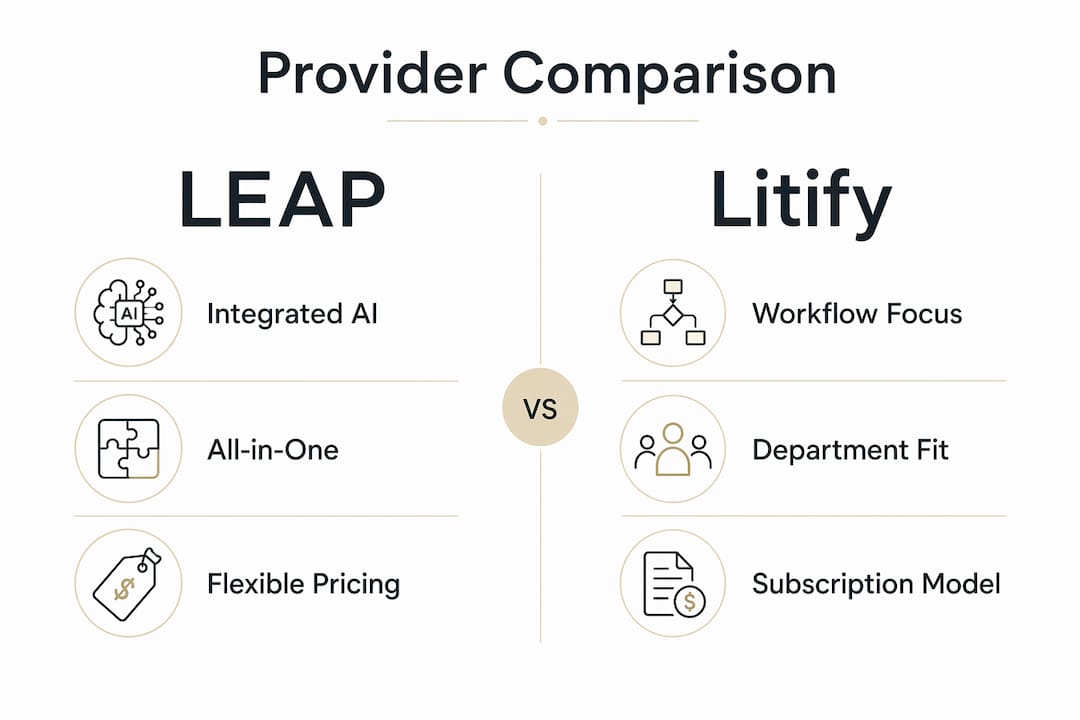
New York legal professionals evaluating document automation software need to match vendor capabilities to their actual workflow, not just their wish list. The table below maps each provider across the dimensions that matter most for a purchasing decision.
| Provider | Services Offered | Specialization | Pricing Model | Unique Positioning | Rating |
|---|---|---|---|---|---|
| LEAP Legal Software | Case management, document automation, legal accounting, billing, AI legal tools | Small to medium law firms, all-in-one practice management | Subscription per user | Single platform for full practice management with embedded AI | 4.6★ (244 reviews) |
| Litify | Intake, matter management, document management, billing, spend management, reporting, workflow automation, AI insights | Enterprise legal teams, large law firms, legal departments | Enterprise subscription | Real-time workflow visibility with AI-driven legal analysis across complex operations | 4.1★ (28 reviews) |
| Legal Outsourcing 2.0 | Litigation document review, contract extraction and analysis, data breach notification review, legal innovation solutions | Legal process outsourcing, litigation support, contract review | All-in pricing, ~50% below US market rates | ISO 27001 certified; US-licensed attorneys plus technology for high-volume, compliance-grade review | 5★ (1 review) |
LEAP Legal Software suits firms that want to stop managing five separate tools. Its embedded AI handles document generation inside the same environment where attorneys track matters and run billing, which means no data re-entry and no context switching. For a 5-20 attorney firm in New York, that integration alone recovers meaningful time each week.

Litify is built for operations where workflow visibility matters as much as document output. Legal departments managing high case volumes across multiple practice lines benefit from its reporting and spend management modules, which give general counsel a real-time picture of where matters stand and what they cost.
Legal Outsourcing 2.0 fits a different buyer: firms that need high-volume document review or contract analysis without building internal capacity. Its ISO 27001 certification addresses the data security scrutiny that New York firms face under state bar ethics guidance on cloud and third-party data handling.
How do you implement legal document automation without losing control?
Deployment is where most automation projects either take hold or quietly collapse. The sequence matters.
Onboarding phases to plan for:
- Template mapping (one-time): During initial setup, your existing clause language, conditional logic, and formatting standards get configured into the platform. This phase typically runs one to two hours and determines the quality of every document the system produces afterward.
- Integration with existing systems: Connecting your law firm automation tools to your case management system, CRM, and billing platform creates a single source of truth. When client data updates in one place, all associated documents cascade automatically, eliminating the version-control problems that plague manual workflows.
- Workflow building and testing: Before going live, map the decision logic for your most common document types. Test conditional clauses against real matter scenarios, not hypothetical ones.
- Human review gates: Successful automation balances AI generation with governed workflows that route documents through attorney review before delivery. Every output needs an audit trail. A document that cannot be defended in a disciplinary proceeding is worse than one that was never automated.
Common pitfalls:
- Firms that route every template change through IT create a bottleneck that kills adoption. Platforms built on low-code editors let attorneys update clause logic themselves, keeping the system current without a development queue.
- Pricing for document automation software ranges from free AI generators for basic use to enterprise subscriptions with advanced workflow and integration features. Implementation costs and ongoing support fees are often underestimated in initial budgets.
Pro Tip: Before signing any vendor contract, ask specifically whether the platform processes your documents on private managed infrastructure or routes data through a shared public AI model. Attorney-client privilege does not survive on infrastructure that retains or trains on your client data. This is a non-negotiable due diligence question for any New York firm.
Subodhkc brings AI governance to legal automation
Legal document automation does not end at document generation. The harder problem is governing the AI that produces those documents: so that outputs are auditable, compliant with New York's AI-specific regulations including NYC Local Law 144, and defensible under professional responsibility standards.
Subodhkc addresses that layer directly. Where LEAP, Litify, and Legal Outsourcing 2.0 handle the document workflow, Subodhkc provides the AI governance architecture that sits beneath it: deterministic compliance frameworks, audit trail design, and risk controls that make AI-generated legal work defensible at the system level, not just the document level. Its HAIEC platform applies structured governance logic to AI operations, giving legal teams the technical evidence trail that regulators and bar associations increasingly expect.
For New York legal professionals who have already chosen or are evaluating a document automation platform, Subodhkc's advisory and governance services answer the question those platforms leave open: how do you prove the AI did what it was supposed to do? That is the accountability layer the market is still building toward, and it is where Subodhkc operates. Start with a governance assessment at subodhkc.com/solutions/haiec.
Key Takeaways
The strongest legal document automation strategy pairs the right platform with a governed AI architecture that produces auditable, defensible outputs.
| Point | Details |
|---|---|
| Match provider to firm size | LEAP suits small to medium firms; Litify targets enterprise legal teams; Legal Outsourcing 2.0 fits high-volume review needs. |
| ISO 27001 certification matters | Legal Outsourcing 2.0 holds ISO 27001 certification, a concrete compliance signal for firms handling sensitive data under New York bar ethics guidance. |
| Template mapping is foundational | A one-time onboarding session configures clause logic and formatting; the quality of this phase determines every document the system produces. |
| Governed workflows protect defensibility | AI generation paired with human review gates and a full audit trail keeps automated documents compliant and professionally defensible. |
| Subodhkc adds the governance layer | Subodhkc's HAIEC platform provides deterministic AI governance and audit trail architecture for legal teams operating automated document workflows. |
Recommended
- CourtCase - Legal Document Organization Tool (Coming Soon)
- Doc Timeline Generator - AI-Powered Document Timeline Extraction
- Subodh KC | AI Systems Architect & Governance Expert
Related Resources
Download the Legal Document Automation Checklist
Enter your email to download the implementation checklist (Markdown).
We will email you the checklist and occasionally send AI governance insights. Unsubscribe anytime.
Get new articles in your inbox
Occasional emails when I publish something worth reading. Unsubscribe anytime.

Subodh KC
Enterprise AI Advisor & AI Systems Architect. Former Sr. Program Manager, HP Inc. Founder of HAIEC - High Assurance In Every Consequence. Builds production AI systems from decision through operation.